Own Your Model
Preserve Your Mission. Shape What Comes Next.
At small college conferences across the country, at least one session outlines the 'broken business model' of traditional, residential undergraduate education. It is evident that enrollment pressure, margin compression, faculty capacity constraints, and shifting student expectations are reshaping the economic foundations of higher education.
I tend to nod along with these common pronouncements, because I too believe that small colleges need to pursue significant transformation.
However, I've started to hear something beyond acknowledgement of a broken business model that I disagree with. I've heard college presidents and financial consultants begin to suggest the residential undergraduate experience is beyond repair. This axiom gaining traction suggests that the only way to achieve long-term sustainability is through large, auxiliary revenue streams that subsidize the deficit-producing, traditional undergraduate model. New graduate programs, microcredentials, more fundraising.
These initiatives have proven critical for many campuses, but this axiom implies that the path to prosperity lies in non-core activities. The deeper assumption embedded in this belief is that colleges have lost control of the undergraduate experience as a sustainable driver of fulfilling their mission.
Inherited Models Are Not Owned Models
Most institutions today are running academic and operating models they inherited, not ones they deliberately designed for the next generation of learners. Over time, decisions about course structures, faculty roles, delivery formats, and cost structures were made under very different conditions. Today, many colleges are still operating within those same constraints, even as the environment around them has fundamentally changed.
Some institutions are hoping that financial pressures will ease with time. While understandable, that hope is unlikely to be enough. Continuing to rely on structures built for a different era, while expecting new revenue streams to subsidize them, limits flexibility and postpones the strategic decisions presidents must ultimately confront.
Owning your model means recognizing that your academic portfolio, cost structure, and delivery strategy are choices, not inevitabilities. It means deciding which elements of your institution are core to your mission, and which can be redesigned, shared, or restructured to preserve that mission.
Ownership is not about abandoning tradition. It is about ensuring your model evolves before external pressures force it to.
Why Non-Core Growth Is Harder Than It Looks
It is easy to understand why non-core growth has become so attractive. These initiatives promise expansion, diversification, and a sense of momentum. In many cases, they do create meaningful new revenue, but they are far from guaranteed paths to sustainability.
Launching and scaling new programs requires significant upfront investment and ongoing attention. Competition is intense, marketing costs continue to rise, and many institutions find themselves entering crowded markets dominated by well-capitalized players with scale, brand recognition, and optimized admissions engines. Differentiation is difficult, and margins are often thinner than expected.
In many cases, non-core growth initiatives require significant capital, leadership bandwidth, and marketing investment — all while the underlying undergraduate model remains unchanged. The result is often complexity layered onto fragility.
Even when enrollment grows, expenses often grow with it. The surplus leaders hoped for never fully materializes. Non-core growth can be smart and necessary, but it becomes risky when it functions as a lifeline rather than one lever among many.
When leaders assume the undergraduate experience will never fully work financially, attention and investment naturally shift elsewhere. The core becomes something to manage rather than something to strengthen. Over time, that mindset narrows options and reinforces the very pressures institutions are trying to escape.
The irony is that the small college experience still offers genuinely distinctive experiences: close-knit communities, deep faculty relationships, and immersive learning environments. These are strengths that are difficult for large or online institutions to replicate. These strengths are also typically aligned with institutional missions.
What has eroded is not the value of the experience, but the alignment between that experience and the operating models used to deliver it.
How To Take Back Ownership of Your Model
If the concern is that the undergraduate experience will always lose money, the response cannot simply be to build around it. It has to include reexamining how it works.
Running a successful residential experience at sustainable margins is possible, but it does not happen by accident, nor does it come from preserving every legacy structure.
Owning your model requires making deliberate choices about where to invest and how to structure delivery. It means deciding what truly differentiates the institution and aligning resources accordingly. It means rethinking course modalities, faculty workload design, shared services, and cost structures in ways that protect mission while improving sustainability.
For many institutions, ownership also requires confronting a difficult question: which parts of the academic model must be built and maintained internally, and which can be shared, redesigned, or delivered differently without compromising institutional identity?
This is where many institutions stall. Tradeoffs feel uncomfortable. Change can feel personal. But avoiding decisions further locks in today’s pressures and pushes harder choices into the future.
Owning your model means taking responsibility for the system as a whole and shaping it intentionally rather than continuing to operate it by inheritance.
A Different Path Forward
A growing number of institutions are beginning to explore a different path.
Rather than relying on non-core ventures to subsidize the traditional model, they are rethinking the model itself by introducing hybrid academic structure, shared curriculum models, and flexible cost frameworks that allow them to expand high-demand programs without absorbing disproportionate risk.
These approaches preserve what is irreplaceable about the residential experience — mentorships, community, identity — while modernizing the academic infrastructure that supports it. The institutions that will thrive in the next decade will be those that deliberately design models aligned to their mission, economics, and students.
If your cabinet, board, or leadership team assumes that the core undergraduate model will never be financially sustainable, what decisions does that belief force you to make? And just as importantly, what options might you be prematurely eliminating by treating that assumption as settled fact?
These questions do not demand immediate answers. But they do demand space for institutional leaders to examine which constraints are structural realities, and which are inherited assumptions.
Owning your model begins with that choice.
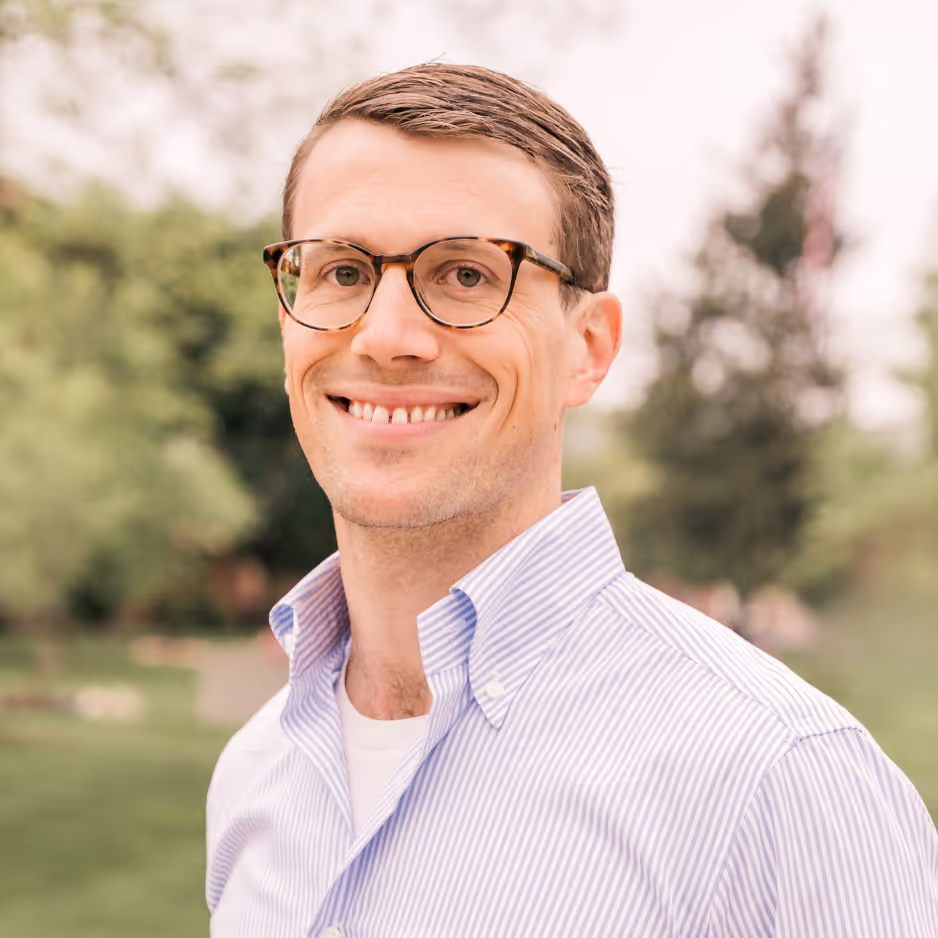
Kevin co-founded Rize Education in 2019. After working on Wall Street for The Blackstone Group, Kevin moved to rural Michigan, along with Rize’s other co-founders, to learn first hand about the challenges facing higher education at Adrian College. His deep passion for expanding access to education and economic mobility is core to everything we do at Rize.
Own Your Model
Preserve Your Mission. Shape What Comes Next.
At small college conferences across the country, at least one session outlines the 'broken business model' of traditional, residential undergraduate education. It is evident that enrollment pressure, margin compression, faculty capacity constraints, and shifting student expectations are reshaping the economic foundations of higher education.
I tend to nod along with these common pronouncements, because I too believe that small colleges need to pursue significant transformation.
However, I've started to hear something beyond acknowledgement of a broken business model that I disagree with. I've heard college presidents and financial consultants begin to suggest the residential undergraduate experience is beyond repair. This axiom gaining traction suggests that the only way to achieve long-term sustainability is through large, auxiliary revenue streams that subsidize the deficit-producing, traditional undergraduate model. New graduate programs, microcredentials, more fundraising.
These initiatives have proven critical for many campuses, but this axiom implies that the path to prosperity lies in non-core activities. The deeper assumption embedded in this belief is that colleges have lost control of the undergraduate experience as a sustainable driver of fulfilling their mission.
Inherited Models Are Not Owned Models
Most institutions today are running academic and operating models they inherited, not ones they deliberately designed for the next generation of learners. Over time, decisions about course structures, faculty roles, delivery formats, and cost structures were made under very different conditions. Today, many colleges are still operating within those same constraints, even as the environment around them has fundamentally changed.
Some institutions are hoping that financial pressures will ease with time. While understandable, that hope is unlikely to be enough. Continuing to rely on structures built for a different era, while expecting new revenue streams to subsidize them, limits flexibility and postpones the strategic decisions presidents must ultimately confront.
Owning your model means recognizing that your academic portfolio, cost structure, and delivery strategy are choices, not inevitabilities. It means deciding which elements of your institution are core to your mission, and which can be redesigned, shared, or restructured to preserve that mission.
Ownership is not about abandoning tradition. It is about ensuring your model evolves before external pressures force it to.
Why Non-Core Growth Is Harder Than It Looks
It is easy to understand why non-core growth has become so attractive. These initiatives promise expansion, diversification, and a sense of momentum. In many cases, they do create meaningful new revenue, but they are far from guaranteed paths to sustainability.
Launching and scaling new programs requires significant upfront investment and ongoing attention. Competition is intense, marketing costs continue to rise, and many institutions find themselves entering crowded markets dominated by well-capitalized players with scale, brand recognition, and optimized admissions engines. Differentiation is difficult, and margins are often thinner than expected.
In many cases, non-core growth initiatives require significant capital, leadership bandwidth, and marketing investment — all while the underlying undergraduate model remains unchanged. The result is often complexity layered onto fragility.
Even when enrollment grows, expenses often grow with it. The surplus leaders hoped for never fully materializes. Non-core growth can be smart and necessary, but it becomes risky when it functions as a lifeline rather than one lever among many.
When leaders assume the undergraduate experience will never fully work financially, attention and investment naturally shift elsewhere. The core becomes something to manage rather than something to strengthen. Over time, that mindset narrows options and reinforces the very pressures institutions are trying to escape.
The irony is that the small college experience still offers genuinely distinctive experiences: close-knit communities, deep faculty relationships, and immersive learning environments. These are strengths that are difficult for large or online institutions to replicate. These strengths are also typically aligned with institutional missions.
What has eroded is not the value of the experience, but the alignment between that experience and the operating models used to deliver it.
How To Take Back Ownership of Your Model
If the concern is that the undergraduate experience will always lose money, the response cannot simply be to build around it. It has to include reexamining how it works.
Running a successful residential experience at sustainable margins is possible, but it does not happen by accident, nor does it come from preserving every legacy structure.
Owning your model requires making deliberate choices about where to invest and how to structure delivery. It means deciding what truly differentiates the institution and aligning resources accordingly. It means rethinking course modalities, faculty workload design, shared services, and cost structures in ways that protect mission while improving sustainability.
For many institutions, ownership also requires confronting a difficult question: which parts of the academic model must be built and maintained internally, and which can be shared, redesigned, or delivered differently without compromising institutional identity?
This is where many institutions stall. Tradeoffs feel uncomfortable. Change can feel personal. But avoiding decisions further locks in today’s pressures and pushes harder choices into the future.
Owning your model means taking responsibility for the system as a whole and shaping it intentionally rather than continuing to operate it by inheritance.
A Different Path Forward
A growing number of institutions are beginning to explore a different path.
Rather than relying on non-core ventures to subsidize the traditional model, they are rethinking the model itself by introducing hybrid academic structure, shared curriculum models, and flexible cost frameworks that allow them to expand high-demand programs without absorbing disproportionate risk.
These approaches preserve what is irreplaceable about the residential experience — mentorships, community, identity — while modernizing the academic infrastructure that supports it. The institutions that will thrive in the next decade will be those that deliberately design models aligned to their mission, economics, and students.
If your cabinet, board, or leadership team assumes that the core undergraduate model will never be financially sustainable, what decisions does that belief force you to make? And just as importantly, what options might you be prematurely eliminating by treating that assumption as settled fact?
These questions do not demand immediate answers. But they do demand space for institutional leaders to examine which constraints are structural realities, and which are inherited assumptions.
Owning your model begins with that choice.
Kevin co-founded Rize Education in 2019. After working on Wall Street for The Blackstone Group, Kevin moved to rural Michigan, along with Rize’s other co-founders, to learn first hand about the challenges facing higher education at Adrian College. His deep passion for expanding access to education and economic mobility is core to everything we do at Rize.